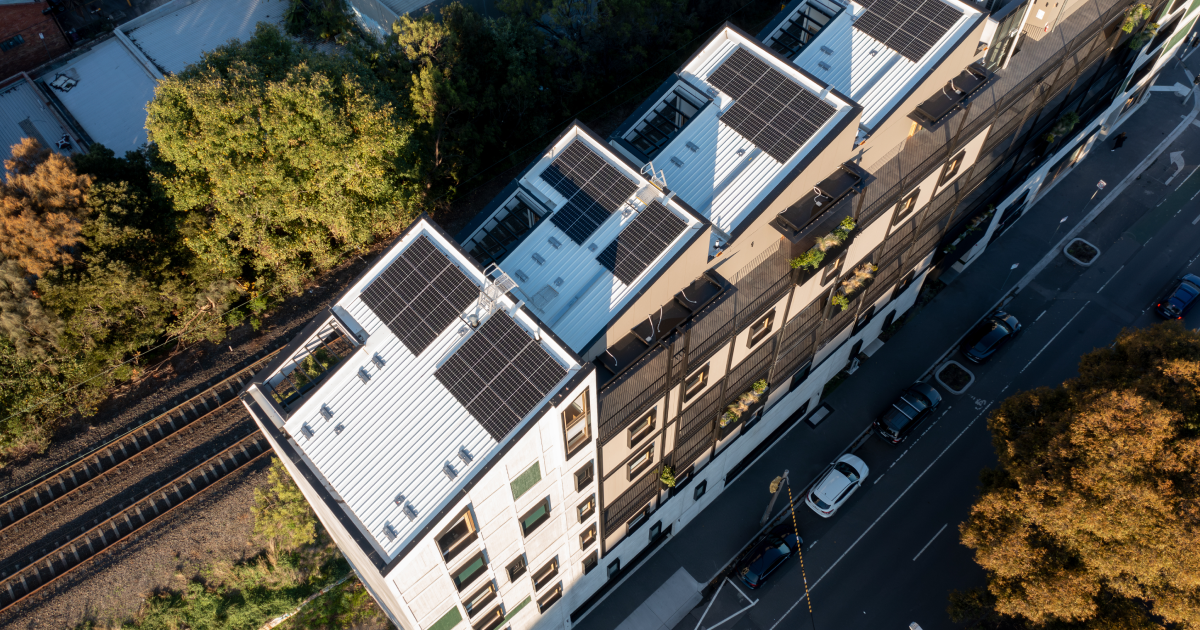
A few weeks ago I attended a lecture by Melbourne based architect Liam Wallis of HIP V. HYPE. The lecture is on youtube here, and while in New Zealand Liam was also interviewed by Bernard Hickey on his podcast When the Facts Change - both are great listens.
Liam talked about his work on the Nightingale projects in Sydney focusing on efforts to achieve sustainable, affordable apartments with low operational energy costs. Along the way he mentioned how they used embedded networks in all their projects.
It was only a brief mention, but as an electricity industry nerd it got me thinking. Are embedded networks (perhaps easier described as electricity micro grids) the answer to getting more solar on apartment buildings in New Zealand?
First, let’s talk about solar
Rooftop solar is taking off on commercial buildings. Large, low pitch surfaces located close to where there is high demand - makes perfect sense.
An area where rooftop solar hasn’t taken off (yet) is apartment buildings. Why not? The challenge is the interface between the supply side and the demand side. In a commercial environment there is generally a single occupier using large amounts of energy while the sun is shining.
In an apartment building it’s a bit more complex. There’s a Body Corporate using a relatively small amount of electricity (lights, lifts, etc) and then a collection of apartments which follow a residential usage pattern: morning spike and evening spike.
There are a lot more parties involved than in the commercial case, and the timing of demand doesn’t match the timing of solar generation. This makes it harder to create a clear business case for any one party.
The Body Corporate ultimately controls the roof though, so let’s start there. We’ll use a building I’m involved with as an example and do some back of the napkin math.
We have an elevated roof that gets near perfect sun and is unused except for a couple of TV satellite dishes. According to the GenLess calculator, we could fit a 20 kW system on the roof, generating 25,000 kWh annually. At my current daytime rate of 26 cents per kWh that’s a potential value of $6,500. So far so good, but realising that value is harder than it seems.
The Body Corporate’s electricity bill annually is 3,500 kWh, and it’s mostly for lighting, which only turns on when the sun isn’t shining. We won’t be able to use most of that solar. What else can we do with it?
Battery + Solar
Batteries are used to shift load over short periods, e.g. storing solar electricity generated during the day to be used to power lights at night. With the help of a battery we could completely cover the Body Corporate’s usage. But that’s only a 7th of what we’re capable of generating - what would we do with the rest?
Sell it on the spot market
In New Zealand the cost of generation only makes up a third of the cost of electricity, and the rest is transmission and distribution. Maintaining the network that transports that electricity around is really expensive! If we sell our excess electricity on the market then we could get about 10c per kWh for a total of $2,500. Not bad, but I think we can do better.
Distribute it directly to residents
To someone else, our electricity is worth only the generation rate because it still needs to be delivered to it’s destination. But if we can deliver electricity directly to a resident in our building then it’s worth anything up to what their provider is charging per kWh (around 26 cents). There’s an opportunity here to provide revenue for the Body Corporate, while also saving residents on their power bill. Sounds like a winner to me.
But how would this actually work? Our building is not wired such that electricity can pass from our rooftop solar directly to an apartment, and even if it were, how would we fairly distribute and price it?
Enter the embedded network
My knowledge of embedded networks is pretty limited and dates from when I worked at Flick Electric: I never heard a good word about them. They were a pain to deal with technically and introduced pricing complexity. In many cases we simply did not supply those buildings.
Embedded networks are often installed in apartment buildings, creating a gate between the micro grid within the building, and the national grid outside. This is sold to the Body Corporate as a way to generate revenue. Take this explanation from google:
Embedded networks allow body corporates and commercial building owners to generate revenue from the electrical infrastructure they already own and are responsible for maintaining.
It’s all about clipping the ticket to generate revenue for the Body Corporate and the embedded network provider who also take a cut. What’s left unsaid is that residents end up paying a higher price for electricity and are often limited in their choice of provider. Not a great outcome I’d say.
But the way Liam talks about embedded networks is different: They are not a middleman taking a cut or a revenue source for the body corporate, but a way of distributing and metering electricity generated from rooftop solar.
The embedded network manages the distribution of the solar energy generated on site: First to the Body Corporate, second to residents, and thirdly, once those needs are met, to the national grid.
What this could look like to a resident is two electricity bills each month: one from the Body Corporate for the rooftop solar they have consumed and one from their existing retailer. Or, as is done in Australia by South Street Energy for the Nightingale projects, by passing the solar energy to residents for free.
An apartment would consume electricity from rooftop solar when it’s available, and their existing retailer when it’s not. The price for the solar electricity would be set by the Body Corporate at a rate that is lower than any retail rate, but could be slightly higher than the cost of generation.
Let’s go back to our napkin math and set this price at 10 cents per kWh. By selling 80% of their electricity to residents on site the Body Corporate would make $2,000 in revenue, while also saving their residents $3,200 (based on the same daytime rate as before). Win win.
A portion of the Body Corporate’s electricity bill would also be covered by the solar generation - another win, and there may be some additional revenue from selling unused capacity onto the grid. Not to mention the less direct but equally important benefits: Reduced load on the grid, and more renewable energy.
So where does that leave us?
Are Embedded Networks the key to unlocking solar on body corporate rooftops? I think they are but I’d love to hear reasons this might not be the case.
Capital investment remains a huge challenge, and I haven’t even talked about payback periods - that’s a topic for another post! Even if the payback period is appealing, I can’t think of any Body Corporate in a financial position to take this on.