
This week is about seeing what needs doing and getting it done with less back and forth. In order: one home page with the committee's jobs on it, New Zealand proposals decided without a meeting, a choice of meeting kinds, a register of conflicts of interest, and a payment reference for every unit.
One home page, with the committee's jobs on top
The committee used to have a dashboard of its own, with checks that said what was wrong but not what to do about it.
Owners and committee members now open Quarter on the same Home page. Committee members see Committee jobs to be done at the top, one line for each thing that needs attention. Owners who aren't on the committee don't see it.
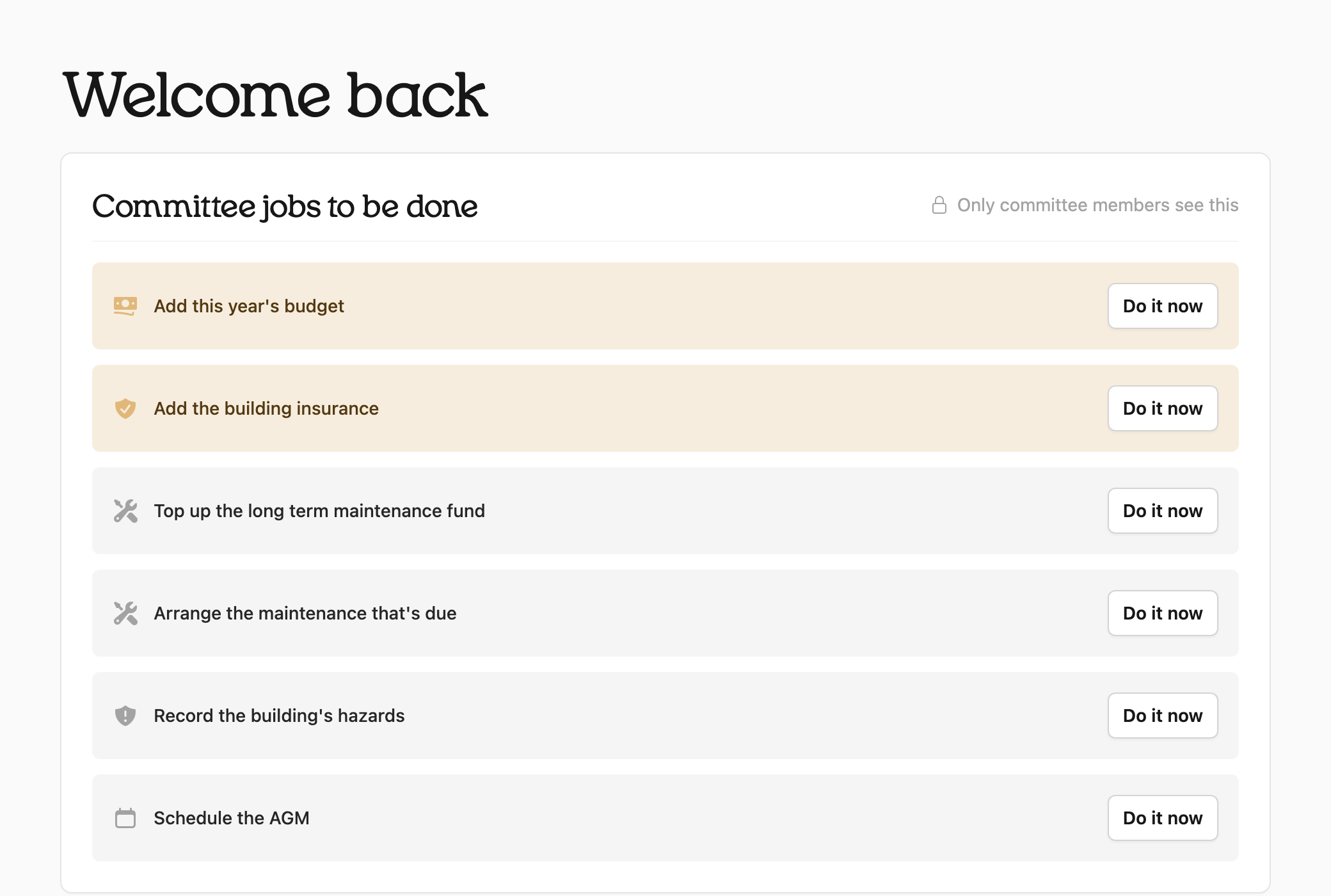
Press Do it now beside a job to go where it's done.
Decide proposals without a meeting in New Zealand
Calling a general meeting to decide one proposal takes weeks, and many proposals don't need the discussion.
In New Zealand, an owners' proposal is now decided without a meeting by default, as the Unit Titles Act allows. The chair issues a notice and owners have 21 days to sign. It passes once enough homes have signed: 75% of the homes that can vote for a special resolution, more than half for an ordinary one.
The chair sees You're the chair on the proposal, with an Issue the notice button, and sees who gets it by email and who by post before it goes. Owners then press Sign in favour or Vote against for each home they own, and can change their vote until voting closes.
Choose the kind of meeting, including informal events
Not every get-together is a formal meeting, and not every committee meeting needs a video link.
On Meetings, New meeting now starts with a choice: annual general meeting, your building's other general meeting, a committee meeting, or an Informal event such as a working bee.
Pick a card and the form asks only what that kind needs. Fill in the location if people can attend in person, and tick Let people attend online if they can join by video, or both. Saving an informal event emails every owner and resident a calendar invitation.
Note: A meeting held only in person gets no video room, so there are no drafted minutes.
A register of conflicts of interest
Committee members sometimes have a stake in what the committee decides, and the law expects that to be disclosed and recorded.
On Meetings, press Conflicts of interest, then Disclose an interest. Record what it's about, its value if known, any proposal it relates to, and when the committee was told. A member records their own, and the chair can record one for any member. On a committee decision, members are asked whether they have an interest, with a Disclose it link.
Where the law says a member with an interest can't vote, as in New Zealand, New South Wales, Queensland and Western Australia, Quarter doesn't count their vote on that decision. Download gives you a copy to hand over, and in New Zealand an AGM notice has an Attach the register button.
A payment reference for every unit
Invoice numbers change with every invoice, so a regular payment set up with one relied on the owners bank account staying the same for levies to be reconciled automatically.
Every unit now has its own payment reference, which never changes. Find it under How to pay on an invoice, in invoice and reminder emails, and as Payment reference on the unit's page. Owners can set up one regular payment with it.
Where your building's bank account is connected to Quarter, a payment quoting the reference is matched to the unit automatically.